The History of the Thirteen Colonies
You will be creating a PowerPoint presentation that should be between three to five minutes. It will either be on one of the Thirteen Colonies:
The New England Colonies:
•Rhode Island
•Massachusetts
•Connecticut
New Hampshire
•The colony was founded in 1629.
•The colony was founded by John Mason. He was a sailor, colonizer and also he was a captain who participated in the founding of Portsmouth in 1630, gave a New Hampshire its name.
•The first people of the colony were English settlers.
•Throughout the 1600s, people in New Hampshire made their living through a combination of fishing, farming, cutting and sawing timber, shipbuilding, and coastal trade.
•By the first quarter of the 1700s, the provincial capital of Portsmouth had become a thriving commercial port, exporting timber products and importing everything from food to European finery.
•Population data from inception to 1776:
1630 =500 people
1700 =5 000 people
1770 =62 400 people
*2007 =1 315 828 people
•New Hampshire was a Royal Province until 1771 except for two short periods, 1642-79 and 1690-92, when it was under the control of Massachusetts. Because of New Hampshire's status as a Royal Province, it was in the peculiar position of separating the two parts of the Massachusetts Bay Colony, present-day Maine and Massachusetts.
•After a 38-year period of union with Massachusetts, New Hampshire was made a separate royal colony in 1679. As leaders in the revolutionary cause, New Hampshire delegates received the honor of being the first to vote for the Declaration of Independence on July 4, 1776.
The Middle Colonies:
New York
Founders
• There used to be a large area of the West Coast that was founded by the Dutch called Nieuw- Nederland meaning “New Netherlands”
• The Dutch were the first to settle there but in 1664 the British took over and it became the colony of New York. Named after James The Duke Of York.
• They say the Duke of York is the founder because the state is named after him.
Culture
•There were Native American tribes living in the area before the Europeans came
•There was the Iroquois that lived in the western part of the colony but with the colonial western expansion being unlimited they got moved further west.
•The Algonquins were another tribe they lived in the Hudson Valley and on Long Island ( also known as the Lenape People ). They were respected and known for being a peaceful group of people.
• When the Europeans came they tried to change the way that the Native Americans lived and ran the areas they lived in which didn’t make the Natives very happy.
• The Europeans moved to New York because it was the biggest trading post out of the colonies. There was also more land there then in Europe so many people came for the farming opportunities.
• Many Patriots lived in New York and didn’t like how it was a British Colony.
• New York played a large role in the fur trade
Population
• 1630 – 250
• 1680 – 9830
• 1720 – 3619
• 1780 – 210, 541
•New Jersey
Pennsylvania
Year Founded- 1684
Who founded it? - William Penn
Culture- Quakers
•Relatively strict Christians
•Refused to bow or take off their hats to Social Superiors
•Believed all men equal under god
•Refused to say oaths of loyalty to the king
•Refused to pay taxes to carry on wars
•Did not swear....Population in 1790 was 434,373 people.
•Delaware
The Southern Colonies
•North Carolina
South Carolina
- Founded in 1670 by eight nobles with a Royal Charter from Charles II.
- The Royal Charter allowed the nobles to settle in the area south of Virginia.
- Because of internal problems the colony was divided into North and South Carolina in 1729. From that point on the crown controlled the colony.
- This colony was one of the wealthiest colonies.
- It was also the colony that had the most battles fought on its land.
- In the year 1670 when the colony of South Carolina was first created there were 200 people that lived in it.
- By the year 1776 when the American Revolutionary War started the amount of people living in the colony of South Carolina had soared to 124,244.
1776 1760 1750 1740 1730 1720 1710 1700 1690 1680 1670
124244 94074 64000 45000 30000 17048 10883 5704 3900 1200 200
- South Carolina became a royal colony in 1729. It was the second last colony to become a royal colony. Georgia became a royal colony in 1752. However five of the thirteen colonies never became royal colonies.
- A group of proprietors founded the colony with the purpose of trading goods and making profits from that.
- The main motivation of the founders of the Southern Colonies was to make money. They brought their family to live on the plantation but they were not the main concern.
Georgia
Georgia was the last colony to be founded in 1732
In 1732 King George issued a charter for the settlement of Georgia.
Georgia was founded by James Edward Oglethorpe in 1732, a British general, and philanthropist
In 1733 114 settlers arrived at the Savannah to establish the new settlement. Most were not from debtor’s prisons.
Georgia’s population in 1776 was around 40,000
Georgia is the eighth fastest-growing state in the U.S., with a population expected to exceed 12 million people by 2030. And that population is getting younger: more than half of Georgians are between the ages of 20 and 54.
The Population of Georgia today is 4,630,841
Royal Georgia refers to the period between the termination of Trustee governance of Georgia and the colony's declaration of independence at the beginning of the American Revolution. During this period the province was administered by the King of England.
Georgia's rich soil and good land attracted people when the first head right and bounty land grants came out in 1776.
In 1828 in Habersham, White and Lumpkin Counties gold was discovered bringing fortune and people to the land.
•Virginia
•Maryland
Future posts will look more closely at each of the groups of colonies.
Identify the following:
• Year founded
• Who founded it?
• Describe the culture of the colony
• Population data from inception to 1776
We will start presentations on Wednesday, October 7, 2009.
See the American History pick up box for the scoring guide.
Monday, October 5, 2009
Friday, September 25, 2009
For Monday....
By Monday or Tuesday at the latest, have your proposal for your research study completed for my review and approval.
It should include:
It should include:
- A review of related literature on the key topics of your problem (research)
- A hypothesis
- An outline of your model (your procedure)

Tuesday, September 22, 2009
To Study or Not to Study
Research Study:
You are about to undertake a study of health care in the United States. Your task will be to conduct a research study that will either: A)help one to understand the American character in terms of what is valued and what is believed to be true and real; or B) explain and/or predict the manner in which the American legislative and political process deals with this issue.
The following provides some examples of the possible research questions:
Does one part of the political process bear more responsibility for the lack of a resolution to the health care issue than another? (i.e. Who is more to blame? Democrats? Republicans? The President? The American Republican system of government? The mainstream Liberal media? Conservative talk radio and Fox News?)
How does media bias (either conservative or liberal) influence people's perceptions with respect to health care?
Which media outlet offers the fairest, most balanced coverage of the health care issue?
How do American attitudes to aspects of their health care system compare to the attitudes of people from other countries to the same aspects of American health care?
What are the trends in health reform in America and what does it tell us about the nation?
As the debate on health care reform moves forward, how does public perception change towards its political leadership and why?
Will politics or the public good prevail in health care? (Public good can be perceived as either a plan being passed or no plan being passed.)
Which is a bigger roadblock to a health care bill -- tort reform/limiting malpractice lawsuits or a public insurance option/socialized medicine?
Is a health insurance plan that requires everyone to buy insurance a tax?
You are to develop your study using the scientific method.
Your model must include the following components:
•research - the background to your problem or question
•hypothesis - a prediction concerning what your study will find or attempt to answer
•variables - things that can change, depending on conditions (independent/dependent)
•procedure - what will be done, in order to get an answer to the hypothesis
•results - findings of executing your procedure
•observation - your records of what you did or studied
•conclusions - a final analysis of whether or not the hypothesis was proved
Before class on Wednesday, consider which question you are interested in and think about the issues you need to learn about to study that question.
Starting next class, I will work with you to help you through the process of developing your model.
You are about to undertake a study of health care in the United States. Your task will be to conduct a research study that will either: A)help one to understand the American character in terms of what is valued and what is believed to be true and real; or B) explain and/or predict the manner in which the American legislative and political process deals with this issue.
The following provides some examples of the possible research questions:
Does one part of the political process bear more responsibility for the lack of a resolution to the health care issue than another? (i.e. Who is more to blame? Democrats? Republicans? The President? The American Republican system of government? The mainstream Liberal media? Conservative talk radio and Fox News?)
How does media bias (either conservative or liberal) influence people's perceptions with respect to health care?
Which media outlet offers the fairest, most balanced coverage of the health care issue?
How do American attitudes to aspects of their health care system compare to the attitudes of people from other countries to the same aspects of American health care?
What are the trends in health reform in America and what does it tell us about the nation?
As the debate on health care reform moves forward, how does public perception change towards its political leadership and why?
Will politics or the public good prevail in health care? (Public good can be perceived as either a plan being passed or no plan being passed.)
Which is a bigger roadblock to a health care bill -- tort reform/limiting malpractice lawsuits or a public insurance option/socialized medicine?
Is a health insurance plan that requires everyone to buy insurance a tax?
You are to develop your study using the scientific method.
Your model must include the following components:
•research - the background to your problem or question
•hypothesis - a prediction concerning what your study will find or attempt to answer
•variables - things that can change, depending on conditions (independent/dependent)
•procedure - what will be done, in order to get an answer to the hypothesis
•results - findings of executing your procedure
•observation - your records of what you did or studied
•conclusions - a final analysis of whether or not the hypothesis was proved
Before class on Wednesday, consider which question you are interested in and think about the issues you need to learn about to study that question.
Starting next class, I will work with you to help you through the process of developing your model.
Monday, September 21, 2009
Stuff You Might Need...
Baucus Bill link....
Here is a summary of the bill below as requested...
http://politicalticker.blogs.cnn.com/2009/09/16/whats-in-baucus-health-care-proposal/
Here is a summary of the bill below as requested...
http://politicalticker.blogs.cnn.com/2009/09/16/whats-in-baucus-health-care-proposal/
Friday, September 18, 2009
Quo Vadis? Where to From Here?
Monday's class will be your last day to work in the lab. You can go directly to room 227 for the beginning of class on Monday.
The health care assignment will be due of Thursday, September 24 at the beginning of class.
Please take time to consider what aspect of the health care debate that you would like to make part of your study as you are working on this introductory assignment.
I will take time on Tuesday and Wednesday to discuss the fundamentals of a good research study and how to write a proposal. You will then begin to write your proposals on Thursday. A deadline will be set soon thereafter and published on the blog.
The health care assignment will be due of Thursday, September 24 at the beginning of class.
Please take time to consider what aspect of the health care debate that you would like to make part of your study as you are working on this introductory assignment.
I will take time on Tuesday and Wednesday to discuss the fundamentals of a good research study and how to write a proposal. You will then begin to write your proposals on Thursday. A deadline will be set soon thereafter and published on the blog.
Wednesday, September 16, 2009
Bills? We Don't Need No Stinking Bills! Chasing the Treasure of Health Care
So now we are on our way...
The task as outlined previously is as follows:
1. Where is the health care debate going?
Track the bills that are in the House of Representatives and the Senate. What do they offer? Who supports them?
2. What does public opinion say about health care?
Find public opinion polling results on questions concerning health care and how that opinion is changing over time. For example, to what extent to Americans support a government operated health option? How has that support changed over the last six months?
3. What are the three strongest arguments on both sides?
In your research, decide on the three best arguments on each side and justify why you think they are the most important.
4. How are people debating this issue in the media?
Check out the ads being run across America right now both in support and in opposition to changes in health care. Is there a pattern? Who is running these ads? Identify the best and worst ads. Do these ads help or hurt the debate? Are they addressing the best arguments their respective side has to make?
While you all are responsible for finding appropriate sources online to meet the requirements of the assignment, here are some examples of the material available to assist you in these endeavors:
1. Where the health care debate is going
Bill Tracking
http://www.opencongress.org/
http://www.govtrack.us/
http://thomas.loc.gov/
Compare Health Care Reform Plans
http://www.kff.org/healthreform/sidebyside.cfm
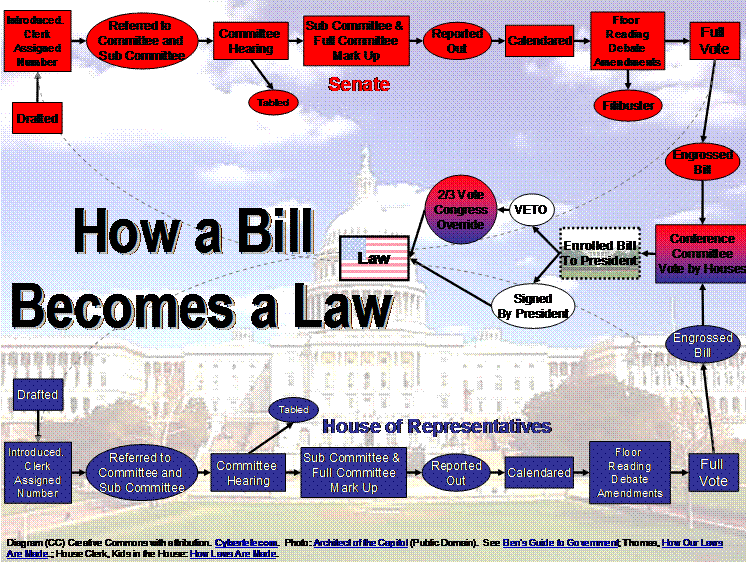
How A Bill Becomes a Law
http://www.cybertelecom.org/images/howlaw.gif
http://www.votesmart.org/resource_govt101_02.php
2. What does public opinion say about health care?
Public Opinion Research
http://www.gallup.com/home.aspx
http://www.pollingreport.com/health.htm
http://www.rasmussenreports.com/content/search?SearchText=health+care
The task as outlined previously is as follows:
1. Where is the health care debate going?
Track the bills that are in the House of Representatives and the Senate. What do they offer? Who supports them?
2. What does public opinion say about health care?
Find public opinion polling results on questions concerning health care and how that opinion is changing over time. For example, to what extent to Americans support a government operated health option? How has that support changed over the last six months?
3. What are the three strongest arguments on both sides?
In your research, decide on the three best arguments on each side and justify why you think they are the most important.
4. How are people debating this issue in the media?
Check out the ads being run across America right now both in support and in opposition to changes in health care. Is there a pattern? Who is running these ads? Identify the best and worst ads. Do these ads help or hurt the debate? Are they addressing the best arguments their respective side has to make?
While you all are responsible for finding appropriate sources online to meet the requirements of the assignment, here are some examples of the material available to assist you in these endeavors:
1. Where the health care debate is going
Bill Tracking
http://www.opencongress.org/
http://www.govtrack.us/
http://thomas.loc.gov/
Compare Health Care Reform Plans
http://www.kff.org/healthreform/sidebyside.cfm
How A Bill Becomes a Law
http://www.cybertelecom.org/images/howlaw.gif
http://www.votesmart.org/resource_govt101_02.php
2. What does public opinion say about health care?
Public Opinion Research
http://www.gallup.com/home.aspx
http://www.pollingreport.com/health.htm
http://www.rasmussenreports.com/content/search?SearchText=health+care
Tuesday, September 15, 2009
The Alamo Pop quiz
Today, you wrote a quiz on the Alamo article. See the quiz below:
- What is the Alamo?
- What took place there?
- Who was involved?
- Why is it considered significant?
- What is the author’s thesis?
- What is the author’s bias?
- Provide an example of this bias.
Subscribe to:
Posts (Atom)